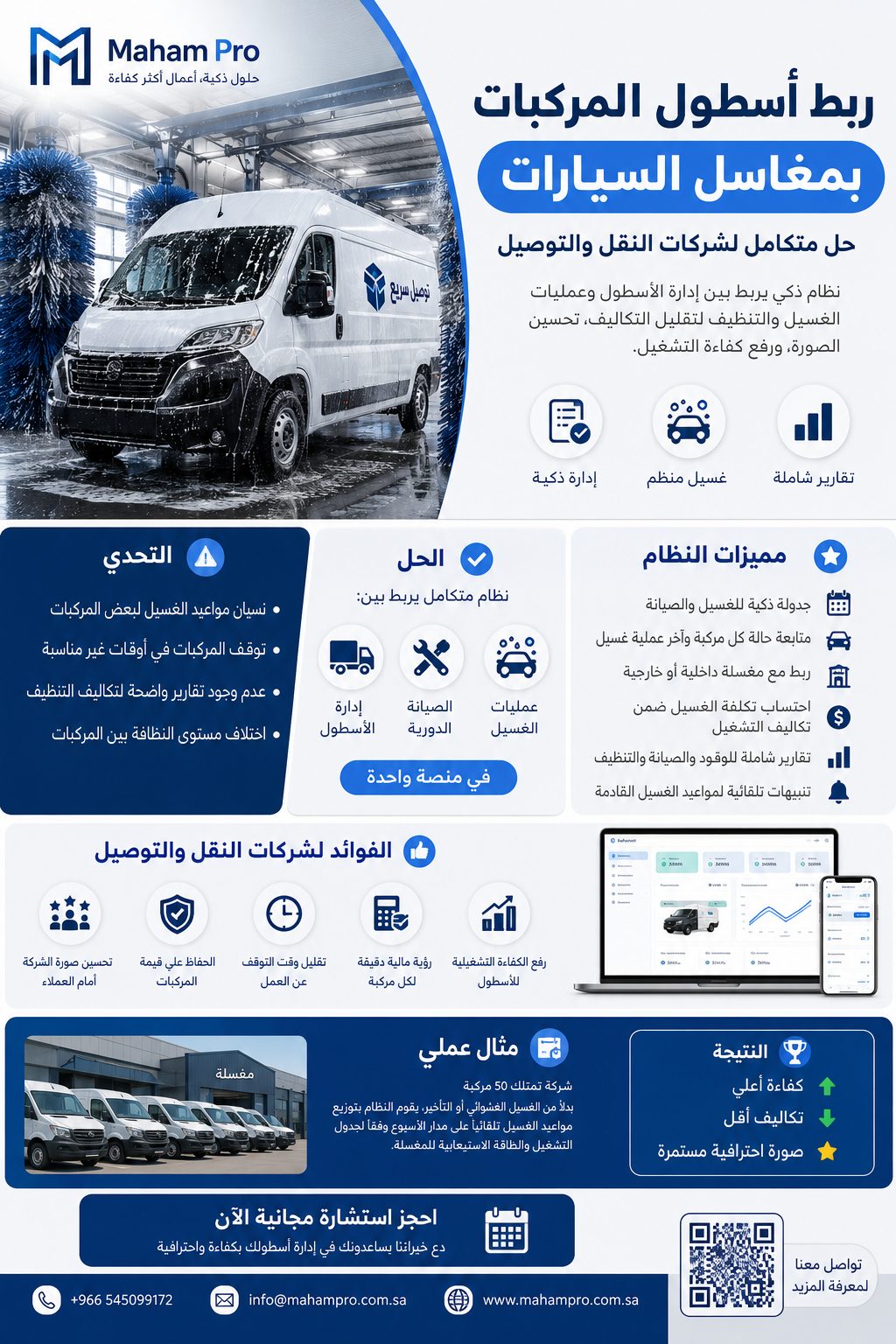
Transport and delivery companies track fuel and maintenance closely, yet vehicle washing usually stays outside the system: drivers wash when they choose, send the receipt late or not at all, and no one knows what keeping the fleet clean costs each month. On the other side, a car wash serving a company with dozens of vehicles needs a different way to record and bill them than it uses for individual customers. This article explains how fleet washing is organised from both sides and what it takes to connect the data between them.
Why fleet washing deserves organising
- Company image: the vehicle is what the customer sees at delivery, and many companies set a cleanliness standard for delivery or passenger vehicles.
- Invisible cost: scattered small wash receipts are hard to collect and review.
- Vehicle downtime: a wash at the wrong time means a vehicle out of service when it is needed.
- Operating conditions: dust and humidity in many regions make regular washing part of vehicle care.
Side one: the fleet company
A clear washing policy
Define for each vehicle category when it is washed: every set number of days, after a number of trips, or before particular trips for specific customers. A written policy ends individual guesswork.
Washing as part of the vehicle schedule
When dispatch sees the wash date next to trips and maintenance, they can place it in the vehicle's downtime or alongside a service appointment instead of cutting into operating time. For more on scheduling maintenance, see vehicle preventive maintenance systems.
Cost per vehicle
Record the cost of each wash against the vehicle itself, as you do with fuel and maintenance. Washing then appears in each vehicle's operating cost, and you can compare it across vehicles and branches.
In-house or partner car wash?
| Option | When it fits | Watch out for |
|---|---|---|
| In-house wash at the company site | A large fleet based at one site | Cost of equipment, labour, water and licences |
| Contract with a partner car wash | A mid-size fleet or one spread across cities | Contract terms, consolidated invoicing and service verification |
| Ad hoc washing on driver receipts | A small fleet | Hard to control and to collect receipts |
Side two: the car wash serving fleets
A fleet customer is different from an individual. The car wash needs:
- A company account with many vehicles under it, each identified by its plate number.
- Contract prices that may differ from walk-in prices.
- A consolidated periodic invoice instead of payment at every wash, with detail per vehicle and date.
- Vehicle verification on arrival, so a car outside the contract is not washed on the company's account.
- Dedicated time slots for the fleet in quiet hours, so it does not crowd out individual customers at peak times.
Contracts like these can be a good way to fill quiet hours, as discussed in improving car wash profitability, and are close to the idea of corporate subscription plans.
Connecting data between the two sides
The simplest link is for the car wash to send a periodic statement of vehicles washed, with dates and costs, which the fleet company matches against its vehicle records. That works at first, but it stays manual.
An automated link means each wash record flows from the car wash system into the fleet system directly, tied to the plate number. To achieve this you need:
- A common vehicle identifier in both systems, usually the plate number.
- Agreement on the data exchanged: plate, date, service, cost, branch.
- An integration interface between the systems, or a periodic exchange file in an agreed format.
- A procedure for exceptions: an unregistered vehicle, or a service outside the contract.
The scope of the link depends on the systems each side uses, so it is defined as a separate project after reviewing them.
Where Maham Pro's products fit
Maham Pro has two separate products: Maham Fleet for fleet management (trips, vehicles with documents and maintenance alerts, drivers, fuel analysis, a driver app and electronic documents), and the car wash management system (orders, customers by plate, queue screen, loyalty, branches, profit and expense reports, permissions). Each runs on its own; connecting them, or connecting either to another system you use, is scoped and delivered as a custom systems project.
FAQ
Do I need an automated link from the start?
Not necessarily. Start with a washing policy and a periodic statement; if volume grows and manual matching becomes a burden, an automated link is worth studying.
How do I verify the car wash did the work?
Ask for a per-vehicle record with date and time, and drivers can upload a photo after the wash from their app if that is part of your procedure.
Does this suit small fleets?
A clear policy and recording cost against each vehicle help at any size. An automated link pays off more with larger fleets.
Next step
Whether you are a transportation or logistics company, or you run a business in the car wash sector and want to serve fleets, book a free 30-minute introductory session to discuss what suits you.